Two chapters finished-- more thoughts to come, but I figured I might benefit from a break form the Wake, so, to honor JJ on his birthday, I read the opening pages of "The Dead", which is often regarded as not only his best story but the finest ever written (in English). But I couldn't get through it. It's great stuff, but the prose was too straight forward. The Wake is poisoning me against standard prose.
Wednesday, February 4, 2015

Sunday, January 25, 2015
10
This week’s Finnegans
Wake adventures have been nothing short of fun and a wee bit clarifying as
well as, of course, confounding. Chapter
one of the first book has been read and reread, so there’s that. My goal of 52 pages a month is almost met, so
that’s even more. And more still: the
second chapter is noted by many critics and scholars as considerably more
approachable, so I feel as though the hard part is over. (Hilarious—the hard
part has not yet begun.)
I don’t claim to understand much of this but I laughed at
least once a page. There's plenty to laugh at among the puns and neogolisms and layers upon maddening layers. And I managed to
follow a good bit of it thanks to Joseph Campbell and Henry Morton Robinson,
John Bishop, and Ronald McHugh. Much has
been made of Joyce’s use of Vico’s La
Scienza Nuova as the structure of the book, and McHugh especially does a
nice job of elucidating the influence, but one other point of his struck me as
fascinating (though I admit it is perhaps the least fascinating aspect of all
this): FW can be cut in four. The first
and third books compliment each other, as do the second and fourth. That balance seems to adhere with other Joycean
tricks, so I’m willing to believe McHugh, but let’s say that Joyce was intent
on using Vico’s idea of the four stages of civilization as his model. That would mean that the first and third
sections, being corollaries, are representative of the theocratic and
democratic stages, while the second and fourth stand in for the aristocratic stage and
chaos, with the end wrapping back to the start and the old thunderclap coming
to bring man back to the wonder of god/theocratic stage.
I’m certain there’s something to these balanced books and something more
to be found in viewing the stages and their corollaries. I don’t know what, but it’s more food for
thought in this grand feast.
More coming, god willing.
Wednesday, January 21, 2015
9
As I dive deeper into some scholarship on The Wake, I'll try to keep these words by Patrick Kavanagh in mind:
“Who Killed
James Joyce?”
Who killed James Joyce?
I, said the commentator,
I killed James Joyce
For my graduation.
I, said the commentator,
I killed James Joyce
For my graduation.
What weapon was used
To slay mighty Ulysses?
The weapon that was used
Was a Harvard thesis.
To slay mighty Ulysses?
The weapon that was used
Was a Harvard thesis.
How did you bury Joyce?
In a broadcast Symposium.
That’s how we buried Joyce
To a tuneful encomium.
In a broadcast Symposium.
That’s how we buried Joyce
To a tuneful encomium.
Who carried the coffin out?
Six Dublin codgers
Led into Langham Place
By W. R. Rodgers.
Six Dublin codgers
Led into Langham Place
By W. R. Rodgers.
Who said the burial prayers? –
Please do not hurt me –
Joyce was no Protestant,
Surely not Bertie?
Please do not hurt me –
Joyce was no Protestant,
Surely not Bertie?
Who killed Finnegan?
I, said a Yale-man,
I was the man who made
The corpse for the wake man.
I, said a Yale-man,
I was the man who made
The corpse for the wake man.
And did you get high marks,
The Ph.D.?
I got the B.Litt.
And my master’s degree.
Did you get moneyThe Ph.D.?
I got the B.Litt.
And my master’s degree.
For your Joycean knowledge?
I got a scholarship
To Trinity College.
I made the pilgrimage
In the Bloomsday swelter
From the Martello Tower
To the cabby’s shelter.
Tuesday, January 20, 2015
8
Last night I read chapter one of Finnegans Wake. Very soon I noticed the name Haroun mentioned,
which struck me as odd because earlier that day I had a conversation with my
wife about the Salman Rushdie book Haroun
and the Sea of Stories, which I rather liked. We decided to decide to keep that book (this
was during a four hour pruning of our library) though it nearly got added to the sell pile. After I told her that
Haroun popped up in The Wake, remarking on the coincidence, she reminded me that while
I spent last summer reading Ulysses,
she was reading The Satanic Verses.
And here was another Joyce-Rushdie connection.
Whoa. It was almost as if
Joyce was drawing a connecting line between himself, this future writer named Salman
Rushdie, and the future readers of these writers: us: me, my wife, our summer of reading, our days at the beach with these thick books in hand, the pleasure of letting the hours pass while we read and soaked up some sun and tried not to get hit by footballs flying over our heads.
Well, of course this is not exactly possible. Still, this coincidence
does confirm what I’d already assumed: the reader of The Wake will find in it
what they bring. Since Joyce spent so many years packing the book with
everything he could think of (and why wouldn’t he think of Haroun, a prophet of
Islam) written in every language within reach (and he reached far and wide) then of
course the book will reflect something of your experience back at you. This is the best means of encouragement for
the early reader of The Wake (that’s me!).
Abandon the need to get every reference and joke and delight in the
surprising amount of things you find that speak to you. See
yourself in the text. Engage with the
book rather than insist that it engage you. Marvel at the connections the book makes to all of time, past and future.
So there, on page 4, I had my mind blown. Can't wait to see what the other 624 pages bring.
More soon.
Sunday, January 18, 2015
7
So this
barista at Starbucks asks me what I’m reading, possibly out of interest or in
order to work me for a tip. I show him the book, Never Any End to Paris by Enrique Vila-Matas.
“What’s
it about?” he asks.
After a
bit of pondering, I simply say: “Everything.”
Now, the
book is not about everything, though it is a wonderful, plotless book full of
literary references and digressions along the lines of the other Vila-Matas
books I’ve read and enjoyed. (If I were to write a novel, it would be in
this vein, loitering and loose and fun, a true response to other
literature.) But I couldn’t possibly describe the entirety of the book to
a barista in Starbucks what with all the people waiting to order. So I
left it at that, dropped some coins in the tip cup, and took myself,
Vila-Matas, and my tea the hell out of there.
This is
my long way of stating that I don’t care if I can’t explain a book to
someone. I had a teacher in high school who said that no book should take
you more than two weeks to get through and that if you couldn’t summarize the
plot when you were finished, you weren’t paying attention. Now that I am
older I know that this— along with so much of what one is told in high school—
is bullshit. (Now that I think of it, my junior year English teacher was
overly fond of mystery novels.) While I see the importance of plot, and
while I love a compelling narrative, I also know that there are different types
of books just as there are different types of people. This is a good
thing.
The type
of books that Vila-Matas writes are not exactly what Joyce was up to, but I
made a connection between the two writers this morning after the
encounter at Starbucks. Stands to reason: I have been thinking about
how to tackle Finnegans Wake in the year 2015 and killing time with
smaller books, like Never Any
End to Paris. Having put out the call for fellow travelers on
Facebook, which I assumed would be ignored, and which, amazingly, netted me one
other sucker crazy enough to give this a go, Mr. Chad Post, I
concocted a plan of attack. 52
pages a month (or 13 pages a week however you slice it). This will allow for a slow yet steady
read of The Wake in one calendar year. So,
after some emails and a few thoughts and a little pre-reading reading of
critical texts and intros, I decided that the best way to read The Wake is to
just read the damn thing. Sure,
some overview of the “plot” and characters and themes will help ground me as I
wade through the puns and neologisms, but I’m not so much looking for a way
into the book as MY way into the book. And
fuck it if I can’t describe the thing to anyone else.
I’m a big fan of the reader response critics and the phenomenologists,
so the idea of an individual reading of any one book appeals to me greatly.
If we are all in different, sometimes overlapping interpretive
communities, we can see how a work of art that challenges, and Finnegans Wake certainly does, is less a dirty
modernist trick and more an invitation for self-discovery, as new agey as that
sounds. I have no idea if I will
actually discover anything by reading The Wake, but it may happen. As I
try to explain to my ENG 101 students, reading is about self-discovery in the
sense that you get to react to things you read. These reactions tell you
something about yourself. The important thing is not to love or hate a
piece of writing but to address why you love or hate it. What does your
reaction mean? How can you articulate that and what might be uncovered
during the articulation?
Self-discovery
was not my intention when starting this blog but, now that I’m reconciled to a
lifelong misunderstanding of The Wake, I shall try to use this space as a means
of exploring whatever comes up during this reading.
And I really don't give a damn if I don’t understand anything
so long as I never stop trying to understand everything.
Wednesday, August 13, 2014
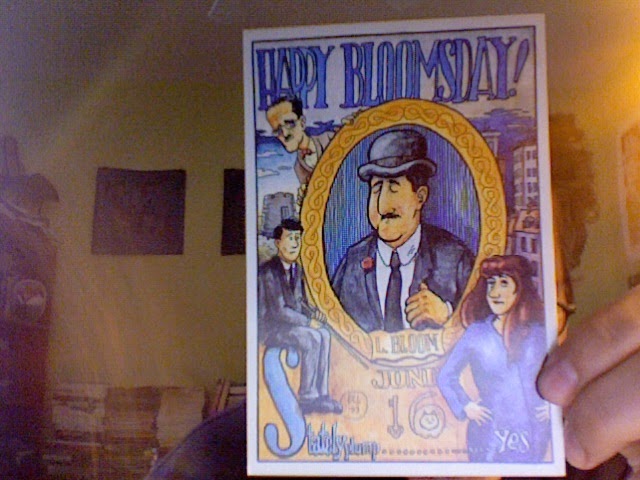
5: The Balance
I
finished Ulysses. To those not
aware of the magnitude of that undertaking, this is my literary equivalent of
finishing a triathlon. I state this knowing that the two are quite
different, but still… the fucking thing took a lot of training, effort, dedication,
patience, resolve, tears, frustration, fear, and did I say effort? I
know, I know… this is a more straightforward book than The Wake, which is the
book I said I wanted to read (and the reason this blog was created). But
I also said that I wanted to warm up with the saga of Leopold Bloom and Stephen
Dedalus and their odyssey around Dublin on that famous June day. I was
anxious to get through it all and to Molly’s famous chapter at the end, which I
did the other day while sitting on a Rogers Park beach, which is where I read a
good chunk of Joyce’s masterpiece.
Hurray for beach reads.
And it is
a masterpiece, a convoluted clusterfucked masterpiece. There can be no
doubt about that. Well… maybe there can be some doubt.
I spoke
with a friend about the task that is Ulysses
and, while doing so, realized that a laborious chore might not make for fun
reading. So why the hell was I doing this to myself? My friend
assured me the endeavor was worth undertaking, that he enjoyed A Portrait of the Artist as a Young Man
and Dubliners considerably more, but
that the satisfaction of finishing Ulysses
was well worth the time and mental energy. (He had not, of course,
been so crazy as to ever try to read The Wake.) And it is a satisfying experience and I am happier to have read the book in its
completion (not a line skipped), even though I fully admit to not getting
everything happening in the tome, for the effect of Ulysses is part of its, er, charm. I had guides and
annotations to help me along the way, but in the end I opted to get though the book largely on
my own and try my damnedest to see what Joyce was up to in each episode.
I did consult a few websites to follow the format and see how it all mirrored The Odyssey, which I haven’t read in
well over two decades, but my ultimate enjoyment was in figuring out the tricks
and intentions to the best of my ability.
So
obviously I ought to tackle The Wake next, right? Nope. I need a
bit of a break. And yes, it took me so long to read Ulysses because I was cheating on it constantly with other books,
mostly poetry. And I started reading Boss
by Mike Royko last night and am looking forward to a conventionally narrated
book of some 200 pages. I need that variety. We all do. With
all the data, media, and gadgets vying for our attention, it may be a good idea
to mix up the literary diet, get some lean protein with the carbs, maybe a
little fiber. Okay, let’s move on
before this analogy gets any more strained.
***
Some
thoughts I had while reading Ulysses:
·
How
the fuck does Joyce get away with this shit?
·
Did
the guy even have an editor?
·
Nora
must’ve been a little pissed over the Penelope episode.
·
Thank
god this was done in 1922 and that no one need try something like it again.
·
I am
in awe of this episode that recreates the history of English, even if it is a
frustrating bunch of pages.
·
The
opening (Telemachiad) and the closing (Nostos) sections are amazing pleasures
to read. The middle (the Odyssey)
is an amazing feat that comprises most of the book and is impressive but more
than once made me want to dig up Joyce and smack his corpse, what’s left of it.
·
It
must’ve been fun to have a polyglot over for parties.
·
This
is a book to be admired and enjoyed, though I am not sure if I enjoyed it as
much as I admire it or if that really matters.
·
This
is surely the antidote to Twitter.
·
Anything
is possible in literature. Joyce
proved as much. But just because something is possible does that mean it is worth doing?
·
There’s
no way this book should be placed above The
Sound and the Fury on anyone’s list of greatest English language novels.
·
Why
aren't we reading this is school?
Or did I go to bad schools?
And
so on.
***
So
I wrote earlier that reading Ulysses
was the equivalent of completing a triathlon, but that is a false analogy. They are very different experiences, I safely
assume. But I used such a lazy comparison
because, 1. It is effective, 2. It makes the point to those who have no real
idea what the hell Ulysses is or why
reading it is a big deal (to me).
But that’s the society we live in, one that automatically recognizes,
quite correctly, the amazing physical effort that goes into training for and
completing a big, crazy athletic event but…
I
was going to write about the modern world and its lack of appreciation for big,
difficult novels, but what the fuck—was everyone reading Ulysses in 1922?
1932? 1948? 1966? 1971?
Nope. Even with computers and
iPhones aplenty, nothing has really changed. So maybe I ought to back off.
***
I
finished Boss last night. Essential reading. I might argue that Ulysses is as well, but I would be less prone to recommend it over
Royko’s unauthorized bio of Richard J. Daley. So why mention them in the same blog post? Because, again, the balanced diet is
important and because they represent two very different books that I think
everyone should familiarize themselves with. Just as I think people should read Bulgakov, Calvino, Ciaran
Carson, Neil Postman, Reinaldo Arenas, G. Cabrera Infante, W. B. Yeats… I think
everyone ought to read a lot and a lot of different things. It’s all essential.
I
have a friend who read fifteen romance novels in a week. Her husband said that she reads too
much. I admit, my first reaction
was, “Romance novels?” But hell—at least the woman is actively
literate. How many people have I
met who employ the loathsome term “post-literate” to describe their lack of
interest in books, as if using such a term exonerates them. It doesn't. You need to read, all the time, everyday, as much as you can, even if what you read is what some might consider fluff. Then again, as
I argued via Facebook of all goddamn places, reading anything is good but one
ought to try a challenge once in a while.
Why? Why is this important? I should have a better answer. My canned response would be something
along the lines of the brain is a muscle and one must exercise or lose muscles,
again using a fucking athletic analogy to make this simple goddamn point. But is this the case? I’ve seen studies that imply that the
reading most done in 21st century America— Facebook, Twitter,
scrolling marquees at the bottom of Fox News broadcasts—is still reading, still
communication via the inorganic means of symbols representing words, words
representing ideas and events.
Just as I no longer lament that the internet is making us lazy and stupid
(a lazy and stupid conclusion), I can also accept that literacy is literacy is
literacy however it is practiced.
But
fuck that.
This
is the same as saying that eating is important to live, so it makes little
difference what one eats so long as they are eating. Which is stupid.
Obviously eating nothing but McDonald’s may have serious health
consequences (We don't need Morgan Spurlock to tell us that). Obviously one ought to balance their
diet a bit and eat some green leafy vegetables as well as pizza. (Last night I
did this—stopped at the corner store and purchased some tomatoes and spinach
to make a nice, simple salad to go along with the frozen pizza I planned to
devour because I fucking love pizza and was very hungry and had spent the
entire train ride home thinking about pizza in ways that are perhaps not
natural or sane. But I
assuaged the wee bit of guilt over eating an entire goddamn pizza by first
making that simple salad and getting some iron in my diet along with the dairy
and starch. See how that works?)
So
read romance novels or Twilight or any
other books that some tweed-wearing douche would dismiss as sub-literate. But maybe try to balance that from time
to time with a more challenging book. It feels
good. It’s good for you. It may force you to consider lives,
ideas, and occurrences outside your comfort zone, but that is also good for
you. It creates empathy,
understanding, a more thoughtful mind.
And
to those who solely read big, difficult books translated from Hungarian
containing more commas than periods per paragraph: maybe lighten up once in a
while and remember those early days when you first read for pleasure and how
much fun a well crafted, nicely plotted book can be.
The
balance. The goddamn balance.
Okay,
more soon, like next year, as that is how long it may take me to read ten pages
of The Wake.
Subscribe to:
Posts (Atom)