I
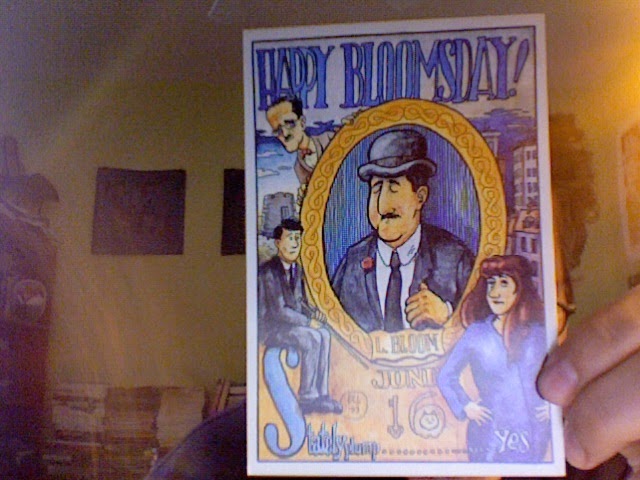
finished Ulysses. To those not
aware of the magnitude of that undertaking, this is my literary equivalent of
finishing a triathlon. I state this knowing that the two are quite
different, but still… the fucking thing took a lot of training, effort, dedication,
patience, resolve, tears, frustration, fear, and did I say effort? I
know, I know… this is a more straightforward book than The Wake, which is the
book I said I wanted to read (and the reason this blog was created). But
I also said that I wanted to warm up with the saga of Leopold Bloom and Stephen
Dedalus and their odyssey around Dublin on that famous June day. I was
anxious to get through it all and to Molly’s famous chapter at the end, which I
did the other day while sitting on a Rogers Park beach, which is where I read a
good chunk of Joyce’s masterpiece.
Hurray for beach reads.
And it is
a masterpiece, a convoluted clusterfucked masterpiece. There can be no
doubt about that. Well… maybe there can be some doubt.
I spoke
with a friend about the task that is Ulysses
and, while doing so, realized that a laborious chore might not make for fun
reading. So why the hell was I doing this to myself? My friend
assured me the endeavor was worth undertaking, that he enjoyed A Portrait of the Artist as a Young Man
and Dubliners considerably more, but
that the satisfaction of finishing Ulysses
was well worth the time and mental energy. (He had not, of course,
been so crazy as to ever try to read The Wake.) And it is a satisfying experience and I am happier to have read the book in its
completion (not a line skipped), even though I fully admit to not getting
everything happening in the tome, for the effect of Ulysses is part of its, er, charm. I had guides and
annotations to help me along the way, but in the end I opted to get though the book largely on
my own and try my damnedest to see what Joyce was up to in each episode.
I did consult a few websites to follow the format and see how it all mirrored The Odyssey, which I haven’t read in
well over two decades, but my ultimate enjoyment was in figuring out the tricks
and intentions to the best of my ability.
So
obviously I ought to tackle The Wake next, right? Nope. I need a
bit of a break. And yes, it took me so long to read Ulysses because I was cheating on it constantly with other books,
mostly poetry. And I started reading Boss
by Mike Royko last night and am looking forward to a conventionally narrated
book of some 200 pages. I need that variety. We all do. With
all the data, media, and gadgets vying for our attention, it may be a good idea
to mix up the literary diet, get some lean protein with the carbs, maybe a
little fiber. Okay, let’s move on
before this analogy gets any more strained.
***
Some
thoughts I had while reading Ulysses:
·
How
the fuck does Joyce get away with this shit?
·
Did
the guy even have an editor?
·
Nora
must’ve been a little pissed over the Penelope episode.
·
Thank
god this was done in 1922 and that no one need try something like it again.
·
I am
in awe of this episode that recreates the history of English, even if it is a
frustrating bunch of pages.
·
The
opening (Telemachiad) and the closing (Nostos) sections are amazing pleasures
to read. The middle (the Odyssey)
is an amazing feat that comprises most of the book and is impressive but more
than once made me want to dig up Joyce and smack his corpse, what’s left of it.
·
It
must’ve been fun to have a polyglot over for parties.
·
This
is a book to be admired and enjoyed, though I am not sure if I enjoyed it as
much as I admire it or if that really matters.
·
This
is surely the antidote to Twitter.
·
Anything
is possible in literature. Joyce
proved as much. But just because something is possible does that mean it is worth doing?
·
There’s
no way this book should be placed above The
Sound and the Fury on anyone’s list of greatest English language novels.
·
Why
aren't we reading this is school?
Or did I go to bad schools?
And
so on.
***
So
I wrote earlier that reading Ulysses
was the equivalent of completing a triathlon, but that is a false analogy. They are very different experiences, I safely
assume. But I used such a lazy comparison
because, 1. It is effective, 2. It makes the point to those who have no real
idea what the hell Ulysses is or why
reading it is a big deal (to me).
But that’s the society we live in, one that automatically recognizes,
quite correctly, the amazing physical effort that goes into training for and
completing a big, crazy athletic event but…
I
was going to write about the modern world and its lack of appreciation for big,
difficult novels, but what the fuck—was everyone reading Ulysses in 1922?
1932? 1948? 1966? 1971?
Nope. Even with computers and
iPhones aplenty, nothing has really changed. So maybe I ought to back off.
***
I
finished Boss last night. Essential reading. I might argue that Ulysses is as well, but I would be less prone to recommend it over
Royko’s unauthorized bio of Richard J. Daley. So why mention them in the same blog post? Because, again, the balanced diet is
important and because they represent two very different books that I think
everyone should familiarize themselves with. Just as I think people should read Bulgakov, Calvino, Ciaran
Carson, Neil Postman, Reinaldo Arenas, G. Cabrera Infante, W. B. Yeats… I think
everyone ought to read a lot and a lot of different things. It’s all essential.
I
have a friend who read fifteen romance novels in a week. Her husband said that she reads too
much. I admit, my first reaction
was, “Romance novels?” But hell—at least the woman is actively
literate. How many people have I
met who employ the loathsome term “post-literate” to describe their lack of
interest in books, as if using such a term exonerates them. It doesn't. You need to read, all the time, everyday, as much as you can, even if what you read is what some might consider fluff. Then again, as
I argued via Facebook of all goddamn places, reading anything is good but one
ought to try a challenge once in a while.
Why? Why is this important? I should have a better answer. My canned response would be something
along the lines of the brain is a muscle and one must exercise or lose muscles,
again using a fucking athletic analogy to make this simple goddamn point. But is this the case? I’ve seen studies that imply that the
reading most done in 21st century America— Facebook, Twitter,
scrolling marquees at the bottom of Fox News broadcasts—is still reading, still
communication via the inorganic means of symbols representing words, words
representing ideas and events.
Just as I no longer lament that the internet is making us lazy and stupid
(a lazy and stupid conclusion), I can also accept that literacy is literacy is
literacy however it is practiced.
But
fuck that.
This
is the same as saying that eating is important to live, so it makes little
difference what one eats so long as they are eating. Which is stupid.
Obviously eating nothing but McDonald’s may have serious health
consequences (We don't need Morgan Spurlock to tell us that). Obviously one ought to balance their
diet a bit and eat some green leafy vegetables as well as pizza. (Last night I
did this—stopped at the corner store and purchased some tomatoes and spinach
to make a nice, simple salad to go along with the frozen pizza I planned to
devour because I fucking love pizza and was very hungry and had spent the
entire train ride home thinking about pizza in ways that are perhaps not
natural or sane. But I
assuaged the wee bit of guilt over eating an entire goddamn pizza by first
making that simple salad and getting some iron in my diet along with the dairy
and starch. See how that works?)
So
read romance novels or Twilight or any
other books that some tweed-wearing douche would dismiss as sub-literate. But maybe try to balance that from time
to time with a more challenging book. It feels
good. It’s good for you. It may force you to consider lives,
ideas, and occurrences outside your comfort zone, but that is also good for
you. It creates empathy,
understanding, a more thoughtful mind.
And
to those who solely read big, difficult books translated from Hungarian
containing more commas than periods per paragraph: maybe lighten up once in a
while and remember those early days when you first read for pleasure and how
much fun a well crafted, nicely plotted book can be.
The
balance. The goddamn balance.
Okay,
more soon, like next year, as that is how long it may take me to read ten pages
of The Wake.